
When to Eat
Getting the timing of your food right can make a real difference to how you feel and perform in training.
You might need to experiment with what you eat pre-exercise to make sure you have enough energy and avoid suffering from stomach cramps.
Pre-Exercise
How you fuel before a run depends on timing, duration, and intensity. The general principle is simple: the longer and more intense the session, the more important it is to arrive well-fuelled. However, it’s important to try to get some fuel in before all your training sessions, even easy runs.
2–4 Hours Before: Your Pre-exercise Meal
If you have time, a meal eaten 2–4 hours before training is the ideal scenario. This isn’t always possible–for example, if you have an early morning session–but do your best with your schedule. Aim for something carbohydrate-focused, moderate in protein, and low in fat and fibre. These slow digestion and can cause gut discomfort when running.
Having enough carbohydrate is important, especially if you have a big session coming up. You should aim for roughly 1 g of carbohydrate per kg of your bodyweight per hour before the session. If you’re a 70 kg runner eating 2 hours out, this means around 140 g.
What does that look like in practice?
- Large bowl of porridge with banana and honey
- Pasta with light tomato sauce and chicken
- Large jacket potato with tuna and a side salad

Photo Cereal Bowl and cornflakes
1 Hour Before: A Small, Easily Digestible Snack
It’s a good idea to top up your energy stores with a small carbohydrate-focused snack (roughly 1 g carbohydrate per kg bodyweight) in the hour before training. Keep it low in fat, fibre, and protein at this point, because these can cause gut issues during your session.
Some examples of this include:
- A banana and a cereal bar
- A handful of dried fruit
- A jam sandwich
- Fruit juice or a sports drink
- Two slices of Soreen
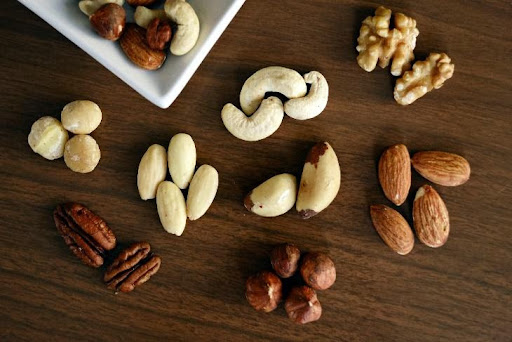
Photo Mixed nuts
Early Morning Runs
How you fuel really depends on the time of day. For early morning sessions, your glycogen stores will be lower after an overnight fast, but you probably have limited time to get food in before your run.
It’s a good idea to try to get some fuel in before running, even if it’s very early. The quality and safety of your session both suffer when carbohydrate stores are depleted.
Try quick, easy to eat and easily digestible forms of carbohydrates, such as:
- A squares bar
- A glass of fruit juice
- A small bowl of Rice Krispies cereal
- A banana
- Sports drink
Afternoon and Evening Runs
If you’re running in the evening, consider making lunch your largest meal of the day, and including plenty of carbohydrates. These can be pasta, potatoes, rice, or grains like couscous, quinoa, buckwheat, etc.
Add a medium-sized pre-run snack 1–2 hours before your session. This will top up your energy stores and ensure you have enough energy to perform well.
Post-Exercise
Recovery nutrition has two jobs: replenishing glycogen stores and providing protein for muscle repair. Eating quickly after training can have a small advantage, particularly if you have another session soon after (e.g. if you are doubling).
However, for most runners doing one session a day, your total daily protein intake matters more than hitting an exact window.
Carbohydrate for Glycogen Replenishment
Aim for around 1–1.2 g of carbohydrate per kg of bodyweight in the first hour or two after training. For a 70 kg runner, that’s roughly 70–85 g of carbohydrate. If you’re training right before a mealtime, this can be folded into your meal.
Protein for Muscle Repair
Alongside carbohydrate, aim for 20–40 g of high-quality protein post-exercise to support muscle protein synthesis. A palm-sized portion of chicken, fish, or eggs, or a scoop of whey protein are all good options.
Many meals and snacks are a combination of the carbs and protein you need for recovery. For example, chocolate milk has a good balance of the two, and is tasty and easy to drink after a session.
Throughout the Day
Rather than front-loading or back-loading calories, spreading food relatively evenly across the day is beneficial for your energy levels and muscle protein synthesis (MPS). MPS responds well to protein distributed across 3–4 meals, where possible, rather than concentrated in one sitting. It’s also easier to eat enough protein when you spread it throughout the day.
Aim for a meal or substantial snack every 3–4 hours. Practically, a meal schedule for a runner training once a day might look like:
- Breakfast
- Mid-training snack
- Lunch
- Pre-training snack
- Post-training recovery snack
- Evening meal
If you’re training twice a day, it might look like this:
- Pre-training snack
- Post-training breakfast
- Mid-morning snack
- Lunch
- Pre-training snack
- Post-training recovery snack
- Evening meal
References
Kerksick, C. M., et al. (2017). International society of sports nutrition position stand: nutrient timing. Journal of the International Society of Sports Nutrition, 14(1). https://doi.org/10.1186/s12970-017-0189-4
Burke, L. M., et al. (2011). Carbohydrates for training and competition. Journal of Sports Sciences, 29(sup1), S17–S27. https://doi.org/10.1080/02640414.2011.585473