
Calorie Requirements
The amount of fuel we need is measured in calories, which is the energy we take in through food and drink. We expend calories through everything our body does, from breathing and keeping warm to running a marathon.
Even when you’re lying in bed doing nothing, the body requires energy to perform its basic functions.
On top of this, every activity you do adds to that requirement. This includes daily movement, like walking to the station or washing dishes, as well as your exercise. For runners, the calorie needs added by your training can be substantial.
Why Population Averages Don’t Apply to Runners
The commonly cited government guidelines suggest around 2,500 kcal/day for men and 2,000 kcal/day for women. You might have seen these on the back of food packets. These are rough population averages for people doing modest amounts of activity. As a runner, especially training for competition, your needs are likely to be considerably higher.
So, how many calories do you need as a runner? This varies depending on many factors: how much you’re training, your weekly mileage, and what you’re doing outside of training, as well as your age and sex. For a sense of scale, research measuring total daily energy needs in female distance runners estimated 3,000 kcal per day, though this will likely be higher during heavier training blocks. Male distance runners were estimated at 4,000–5,000 kcal.
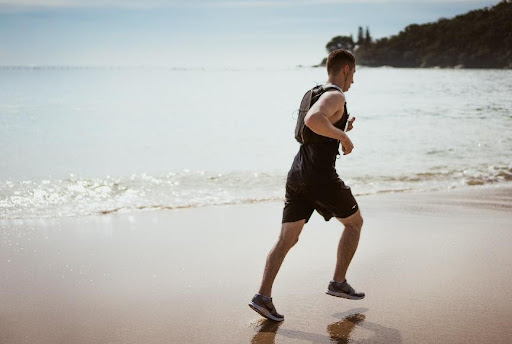
Photo Man running on beach
Estimating Your Daily Calorie Needs
As a useful rule of thumb, running burns approximately 1.6 kcal per kg of body weight per mile. That means a 65 kg runner covering 10 miles burns around 1,040 kcal from the run alone. The total energy “cost” doesn’t vary dramatically with pace. What matters most is the distance covered, yet faster runners can cover more distance in the same amount of time, burning more total calories.
Your total daily calorie needs include your resting metabolic rate (RMR), which is how many calories your body needs to keep functioning, plus your total daily energy expenditure (TDEE). Your TDEE is made up of your runs and workouts, as well as usual daily activities like walking, cleaning, and even fidgeting.
Calculating your needs can give you a starting point, but it’s not an exact science. However, estimating your needs and comparing it to your typical daily intake by food tracking can help you ensure you’re getting enough calories to fuel your training.
There are different prediction equations that can help you calculate how many calories your body burns at rest (RMR). It’s important to keep in mind, though, that these are just a starting point, and they may underestimate calorie needs in athletes.
There are various online calculators available that can help you estimate your daily calorie needs. You can find one here. A sports nutritionist or dietitian can also help you more accurately calculate your needs.
Low Energy Availability and RED-S
Eating enough food is crucially important for athletes. Consuming too little can lead to something called low energy availability (LEA), which means the body isn’t getting enough fuel to support both training demands and overall health. Over time, if LEA continues, it can become Relative Energy Deficiency in Sport (RED-S). RED-S can happen deliberately if you intentionally don’t eat enough, but it can also happen unintentionally if your training load increases and you don’t eat enough to meet your higher needs.
While RED-S can affect any athlete, younger female athletes are more susceptible. It’s important to be aware of this, because adolescent athletes have high calorie needs to support puberty and development, as well as training. While the signs of RED-S are broad, some warning signs to look out for include:
- irregular periods or a loss of periods (amenorrhea)
- recurrent bone stress injuries like stress fractures and stress responses
- persistent fatigue and difficulty recovering from training
- declining athletic performance
- frequent illness
- low mood, irritability, and difficulty concentrating
- disrupted sleep
- slow growth in younger athletes
Early intervention is important because RED-S can cause a range of health concerns if left untreated. If you recognise symptoms in yourself, your child, or another athlete, seek support from a coach or healthcare provider.
References
Mountjoy, M., et al. (2023). 2023 International Olympic Committee’s (IOC) Consensus Statement on Relative Energy Deficiency in Sport (REDs). British Journal of Sports Medicine, 57:1073–1098. https://bjsm.bmj.com/content/57/17/1073.info
Yoshida, A., et al. (2019). Validity of Combination Use of Activity Record and Accelerometry to Measure Free-Living Total Energy Expenditure in Female Endurance Runners. Journal of strength and conditioning research, 33(11), 2962–2970. https://pubmed.ncbi.nlm.nih.gov/29389693/