
Muscle Gain
Many runners feel self conscious or very aware of their weight and size. It’s a common complaint of novice runners, who after taking up the sport to lose weight, find that they’ve not lost much.
However, often this is because they’ve actually gained muscle mass. This is a good thing, and it shows why it’s important to not fixate on the number on the scales.
So, how can you get a better understanding of your body composition (i.e., how much body fat and muscle mass you have)? A healthcare professional can help you measure your body fat with skinfold calipers, or with machines like DEXA and BodPod. You can also get a rough idea of your body fat at home with body fat scales.
Your body fat percentage matters because being both too low and too high can impact performance. Long distance runners may be heard to say things like “if I am lighter I’ll run quicker”. However, for many runners, this won’t be true, as being strong and at a healthy body fat percentage is crucial for sustained performance.
If it is muscles that power our running and a slight person is of the order of 30% muscle, then adding 5% to our body weight as muscle will actually increase our muscle mass by between 15 and 20%. Therefore we have 15–20% more power to push along 5% more weight – which can only make things easier.
Obviously, this has limitations in terms of supply of oxygen to the muscles and therefore our aerobic capacity to run for long periods of time (no-one the size of Jonah Lomu has ever run a fast marathon), but it applies to many athletes on a smaller scale.
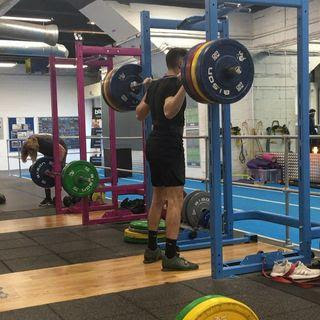
Photo Training with weights
Eating to Gain Muscle and Weight
Weight gain is theoretically fairly simple. If you eat more calories than you use, you will gain weight.
However, athletes are generally looking for muscle gain. To gain muscle mass and therefore power and strength, we need to get stronger. Many athletes who have never done any strength work before will be able to make gains by the use of circuit training. Some novice runners who have been sedentary for many years will get stronger legs from running. However, in the long term the best way to get stronger is to lift weights. Lifting weights is also excellent for your bone mass, which helps prevent fractures and keep us active as we get older.
You can help your body create new muscle tissue by providing it with the right foods. Protein, a macronutrient, is the building block of muscles, and eating more protein can help you gain more muscle and maintain what you have.
But how much protein is the right amount for you? Current sports nutrition guidance recommends around 1.4–2 g per kilogram of bodyweight per day, with higher recommendations at 1.6–2.2 g/kg for those actively trying to build muscle. For a 70 kg athlete, that’s roughly 112–154 g per day.
Consuming the higher end of these guidelines is most relevant during heavy training blocks, or when you’re trying to maintain muscle mass while losing bodyweight. Most people eating a varied diet are likely hitting the lower end of the range, but the upper end can take more planning.
Which foods contain protein? Meat, dairy, eggs, legumes, and soy products are all good sources of protein. However, not all proteins are created equal. Proteins are made up of amino acids, with one specific amino acid called leucine being the key amino acid that triggers muscle protein synthesis. Getting enough leucine at a meal can help your muscle recovery, which is important if your goal is muscle gain.
Animal proteins, in particular dairy, are good sources of leucine. Plant-based proteins, such as legumes and nuts, have lower amounts, so vegan and vegetarian athletes may need to eat slightly more protein to hit the same stimulus.
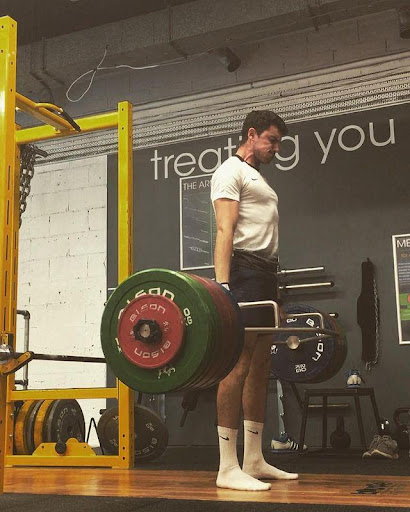
Photo Training with weights
Exercising to Gain Muscle
Hypertrophy is the technical name for muscle growth. The ease with which this can be managed in an individual is genetic so will vary a lot, but the principle is the same for everyone. To get this effect from any sort of exercise the guidelines are reasonably simple.
You need to do exercises for 6–10 repetitions (repeated 3–5 times with a 2–5 minute gap) of exercises where you could do no more than 15 or so in one maximal set.
As a novice to strength training, this could be a whole range of exercises, predominantly, initially, circuits exercises, such as press ups, squats (to varying depths), sit ups etc.
However, very quickly, you’ll be needing to lift weights. The best weights for athletes are ones that involve a large spectrum of muscles, such as Olympic lifts and free weights are almost always preferable to fixed machines – these topics are discussed far more in the Weights section of the site.
Sources
Aragon, A. A., et al. (2017). International society of sports nutrition position stand: diets and body composition. Journal of the International Society of Sports Nutrition, 14, 16. https://doi.org/10.1186/s12970-017-0174-y
Jäger, R. et al. International Society of Sports Nutrition Position Stand: protein and exercise. J Int Soc Sports Nutr 14, 20 (2017). https://doi.org/10.1186/s12970-017-0177-8